
News
Browse selected news below
March update: What’s new at the WHO Hub in Berlin
Mar 31, 2025, 08:37 AM
Welcome to the latest WHO Hub for Pandemic and Epidemic Intelligence news update!
Each month, we bring you the latest updates on our transformative approach to collaborative surveillance so that countries are better equipped to detect, monitor and manage public health threats.
We spotlight key projects, share insights from our experts, recommend resources and highlight upcoming events and opportunities.
Partner voices
“My name is Lina Chaito and I am an epidemiologist working in the surveillance of communicable diseases at the Ministry of Public Health in Lebanon.
In 2024, I joined the GOARN Berlin Fellowship Programme to work on a project focused on strengthening epidemic intelligence activities in Lebanon, with a particular emphasis on improving rabies surveillance.
My goal was to enable earlier detection of rabies cases while they are still within the community to allow timely intervention. I also wanted to identify areas at high risk of rabies exposure.

Becoming a GOARN fellow was a significant milestone in my career as an epidemiologist. The fellowship provided valuable mentorship and connected me with professionals who understood my project and could guide me. I built multiple connections and received valuable feedback from different experts on improving my project.
Beyond the technical aspects, the fellowship also gave me insight into how the team at the WHO Hub in Berlin works to enhance rapid public health threat detection. It was truly inspiring to witness the impact that early detection has on saving lives and containing disease outbreaks. This experience will shape my future career in science and public health.”
📢 Read the full interview with Lina.
📢 Read more about the fellowship programme, a joint initiative of the WHO Hub for Pandemic and Epidemic Intelligence, the Robert Koch Institute and WHO’s Global Outbreak Alert and Response Network.
What to read
Since 2022, the WHO Hub’s Pandemic and Epidemic Intelligence Innovation Forum regularly brings together international experts and thought leaders in the field of pandemic and epidemic intelligence for virtual events.
These discussions cover a wide range of topics, from strengthening the epidemic intelligence workforce and the role of data journalism to harnessing the power of artificial intelligence and more.
You can now explore key insights from Innovation Forum sessions on a dedicated page in the BMC Proceedings journal and sign up to attend future virtual events.

What to watch
High-quality research is essential for advancing pandemic and epidemic intelligence and strengthening public health surveillance.
The WHO Hub, in collaboration with the Charité Center for Global Health, GloPID-R, the WHO Science Division and the Wellcome Trust, has identified 23 key research areas to strengthen global preparedness and response to health emergencies.
Watch this video to see how we’re bringing together researchers, funders and policymakers to focus on urgent priorities, foster interdisciplinary collaboration and turn research into real-world public health solutions.
What to share
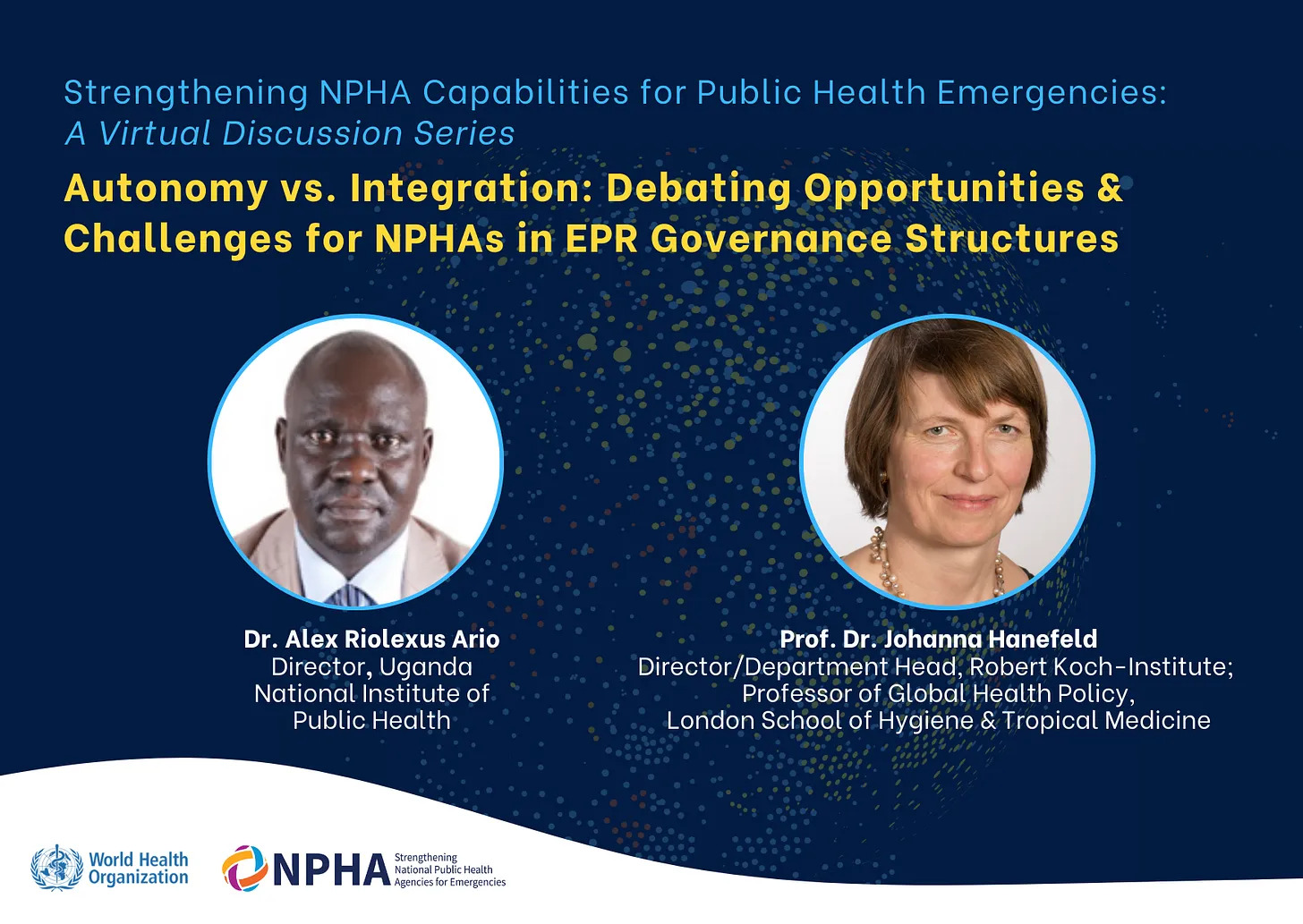
How does the level of autonomy of national public health agencies (NPHAs) impact their ability to make scientific, operational and financial decisions? This critical question brought together around 100 NPHA representatives in our latest online event.
Dr Alex Riolexus Ario (Uganda National Institute of Public Health) and Prof Dr Johanna Hanefeld (Robert Koch Institute) shared insights from Uganda and Germany, showing that while governance models differ, NPHAs face common challenges and opportunities in strengthening emergency preparedness.
Read and share this LinkedIn post with key highlights from the discussion.
Follow us on LinkedIn
The WHO Pandemic Hub is on LinkedIn! Follow us for regular updates in English and German on how we support public health intelligence communities worldwide with innovative solutions, knowledge-sharing networks and stronger systems for better decisions during epidemics and pandemics.
👉 Follow us and leave us a comment, share or like!